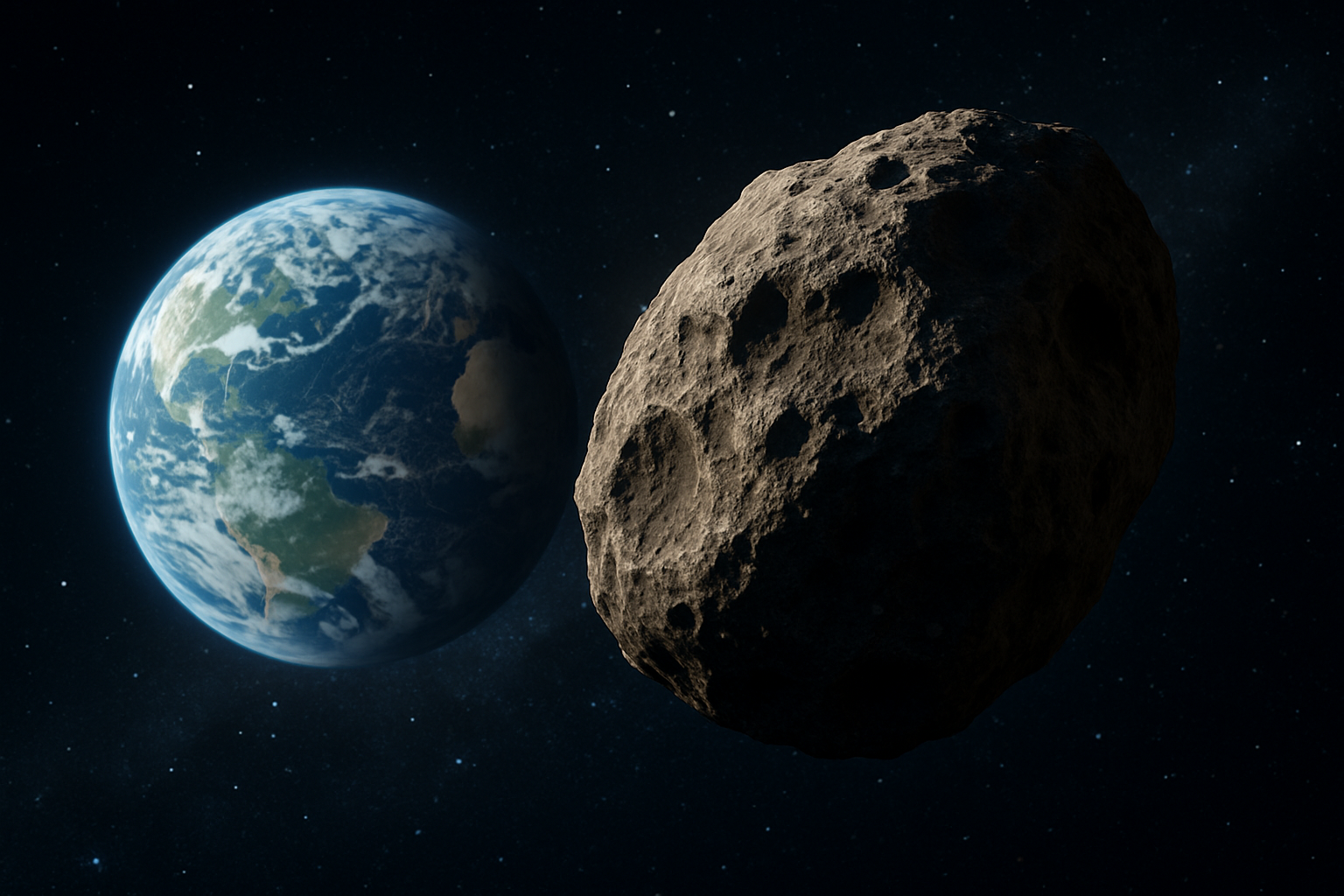
Assessment of Asteroid Collision Risk and Countermeasure Analysis
Assessment of Asteroid Collision Risk and Countermeasure Analysis
This analysis examines the scale of expected damage and necessary countermeasures for a situation where an asteroid approximately 40-90 meters in diameter is predicted to have a 1.9% probability of colliding with Earth in about 7 years.
Calculation of Expected Value (Damage Estimate)
Damage Assumptions: If an asteroid of approximately 50m diameter collides with Earth, its energy would be equivalent to several megatons of TNT explosive. In the 1908 Tunguska event, a celestial body of about 50m diameter exploded in the atmosphere, with power equivalent to 10-50 megatons of TNT, flattening approximately 2,000 square kilometers of forest (about 80 million trees). Fortunately, since it was an air burst over an extremely remote area, there was almost no human damage, but if an explosion of the same scale occurred over a densely populated area, it could devastate an entire city and cause enormous damage.
More recently, in 2013, a meteorite of about 20m exploded over Russia, generating shock waves equivalent to about 400-500 kilotons of energy, causing approximately 1,500 injuries and damage to over 7,200 buildings. In this case (the Chelyabinsk meteorite), the explosion also occurred in the air with limited direct ground damage, but total damage was still estimated at over $33 million (about ¥4 billion).
Estimation of Expected Damage: Damage varies greatly depending on the asteroid's landing point. Human casualties could range from tens of thousands to millions of deaths and injuries if it directly hits a densely populated area, but could be relatively limited if it lands in the ocean or sparsely populated areas. Economic damage could also reach trillions of yen (tens of billions of dollars) if urban infrastructure (buildings, transportation networks, power and communication) is destroyed. On the other hand, if it lands in remote areas or the sea, direct physical damage would be limited, though tsunami damage from ocean impacts to coastal areas should also be considered. Estimating the average damage across these scenarios at roughly several hundred billion to one trillion yen, multiplying by the 1.9% collision probability gives an expected damage of tens to hundreds of billions of yen. For example, assuming an average damage scenario of ¥500 billion (about $5 billion), the expected value would be about ¥9.5 billion (about $0.95 billion). This is a non-negligible risk cost, and considering uncertainty of damage and social impact (spread of fear and confusion), the actual risk assessment should take this expected value more seriously.
Technical Feasibility of Orbital Deflection Project
Existing Deflection Technologies: Fortunately, technology to change asteroid orbits has been developing in recent years. The main methods being researched and verified include:
Kinetic Impactor: A method of crashing a spacecraft into an asteroid to slightly change its orbit through momentum transfer. NASA demonstrated this technique in 2022 with the "DART" mission, successfully shortening an asteroid's (approximately 160m satellite body) orbital period by 32 minutes. This experimental success showed that "orbital deflection through kinetic impact is possible when a dangerous asteroid appears." For a 40-90m class body, it's highly likely that imparting just a few millimeters per second of velocity change using this method could deflect it from an Earth collision course.
Nuclear Explosion Deflection: A method using nuclear warheads to detonate or push an asteroid with blast force. Since directly shattering an asteroid with nuclear blast risks fragments raining down on Earth, the realistic approach aims to change the orbit through shock waves from nuclear detonation near the asteroid. Nuclear weapons can deliver extremely powerful energy, so large orbital changes are expected in short periods, but there are very high technical and legal hurdles for using nuclear weapons in space (conflict with the Outer Space Treaty and Nuclear Test Ban Treaty), and there's no precedent of actual trials.
Gravity Tractor: A method of gradually pulling an asteroid by flying a spacecraft near it using its weak gravity. While maintaining position with propulsion, this gradually shifts the orbit over years to decades, with the advantage of extremely precise control. While long preparation time is needed, humanity has already succeeded in asteroid rendezvous and sample return missions (NASA's OSIRIS-REx and JAXA's Hayabusa missions), so the guidance and control technology foundation for this method exists.
Feasibility Assessment: Among the above, kinetic impactor is currently the most realistic and proven method. With 7 years of lead time, if a plan is launched early, orbital deflection attempts can be made with several years of margin from launch to impact. From DART's success, the technical hurdles for executing similar missions aren't very high, and the precision to hit the target body has been achieved. Even if the first impact provides insufficient orbital change, success probability can be increased by planning to launch and re-impact additional spacecraft. The nuclear option is a last resort, but research is progressing for cases with extremely short lead time or where kinetic impact is insufficient. However, given issues of international consensus-building and safety management for using nuclear weapons in space, realistic options currently favor non-nuclear kinetic methods. Overall, at current technology levels, orbital deflection of a 50m class asteroid is feasible with good prospects for success. What's important is promptly starting the project and hedging risk by considering and preparing multiple countermeasure options in parallel.
Cost Estimate for Countermeasures
Mission Scale and Required Expenses: For countermeasures against a 40-90m class asteroid, we consider kinetic impactor missions as the focus. Required costs consist of spacecraft development/manufacturing, launch rockets, and operational costs. For reference, NASA's 2022 DART mission (asteroid ramming experiment) was allocated approximately $330 million (about ¥36 billion). This amount includes spacecraft development, launch, and operational costs. For this case too, if planning to launch 1-2 impactor spacecraft of similar scale, a budget of several hundred million dollars (several tens of billions of yen) is estimated.
Additional Element Variations: If a nuclear option is adopted, additional costs may be needed for developing special space-grade nuclear devices and safety measures. Costs also increase if multiple backup missions are prepared in parallel. However, the total budget is unlikely to exceed tens of billions of dollars (several trillion yen). Indeed, Russell Schweickart of the B612 Foundation estimated that "asteroid deflection missions can be executed within roughly $5-10 billion (about ¥500 billion to ¥1 trillion) and are by no means infeasible amounts." This is a level that can be adequately covered if countries cooperate and share costs, representing a realistic budget sense. Note that plans should be made with some contingency for preliminary surveys (detailed measurement of asteroid properties and orbit) and backup spacecraft development in case of initial failure.
Cost-Effectiveness Evaluation
Expected Loss vs. Countermeasure Cost: Comparing the expected damage calculated above (tens to hundreds of billions of yen scale) with countermeasure costs (several hundred billion yen scale), both may be roughly the same order of magnitude. At first glance, "investing hundreds of billions of yen for a 1.9% risk" might seem cost-ineffective. However, considering the skew of risk not reflected in expected value calculations (low probability but catastrophic damage), cost-effectiveness should rather be evaluated as sufficiently high. Without countermeasures, there's a non-negligible 1.9% probability of city-devastating disaster. Both human and economic damage would be enormous, with incalculable ripple effects of social impact and confusion. On the other hand, if investing in the countermeasure project can almost certainly avoid that worst-case scenario, the return (disaster avoidance effect) commensurate with expenditure is extremely large.
Social and Economic Perspectives: When evaluating cost-effectiveness, not only pure monetary conversion but also social value must be considered. Values like saving human lives and preserving civilization are beyond monetary measure, and insurance-type investments to "prevent possible worst-case scenarios" are justified in public policy. Indeed, responding to space-scale threats is a duty of nations and international society, and even if risk occurrence probability is low, taking countermeasures is of great significance. In this case too, given a non-negligible 1.9% probability, early initiation of orbital deflection projects for risk reduction will be socially demanded. Cost-wise too, if participating countries internationally cooperate and distribute cost burdens, per-country burden can be reduced. Additionally, technology and knowledge gained from this project contributes to future planetary defense capability improvement, positioning it as a long-term security investment.
Overall Judgment: Considering the above, the orbital deflection project is considered cost-effective. Even if expected damage and countermeasure costs are similar, the significance of preventing disaster before it occurs is immeasurable. Rather, if global catastrophe can be avoided by investing merely tens to hundreds of billions of yen, it's cheap. Therefore, the project should be launched immediately at this stage, with relevant parties (space agencies, governments, defense authorities, etc.) coordinating to begin concrete mission planning.
References:
- CNN reporting via Paul Chodas (NASA/CNEOS) comment: "If the size is large, collision blast damage could extend to a radius of 50km from impact point"
- Britannica Encyclopedia: Overview of "Tunguska Event" (2,000 sq km of forest flattened, energy up to 15 megatons)
- Reuters: "2013 Chelyabinsk Meteorite" damage report (approximately 1,200 injuries, $33 million in damage)
- Arms Control Association: Michael Krepon "Planetary Defense: The Nuclear Option Against Asteroids" – Past meteorite collision cases (Tunguska, Chelyabinsk) and DART mission achievements
- Wikipedia: DART mission (shortened asteroid Didymos satellite orbital period by 32 minutes)
- Space.com: Articles on asteroid deflection (expert comments on technology options and cost estimates available to humanity)
- NASA: Documentation on asteroid orbital deflection technology demonstration through DART mission
- Arms Control Association: Deflection methods through nuclear explosion in space and legal issues
- ResearchGate: Comparative study of asteroid deflection methods (kinetic energy method most feasible for NEOs under several hundred meters)